
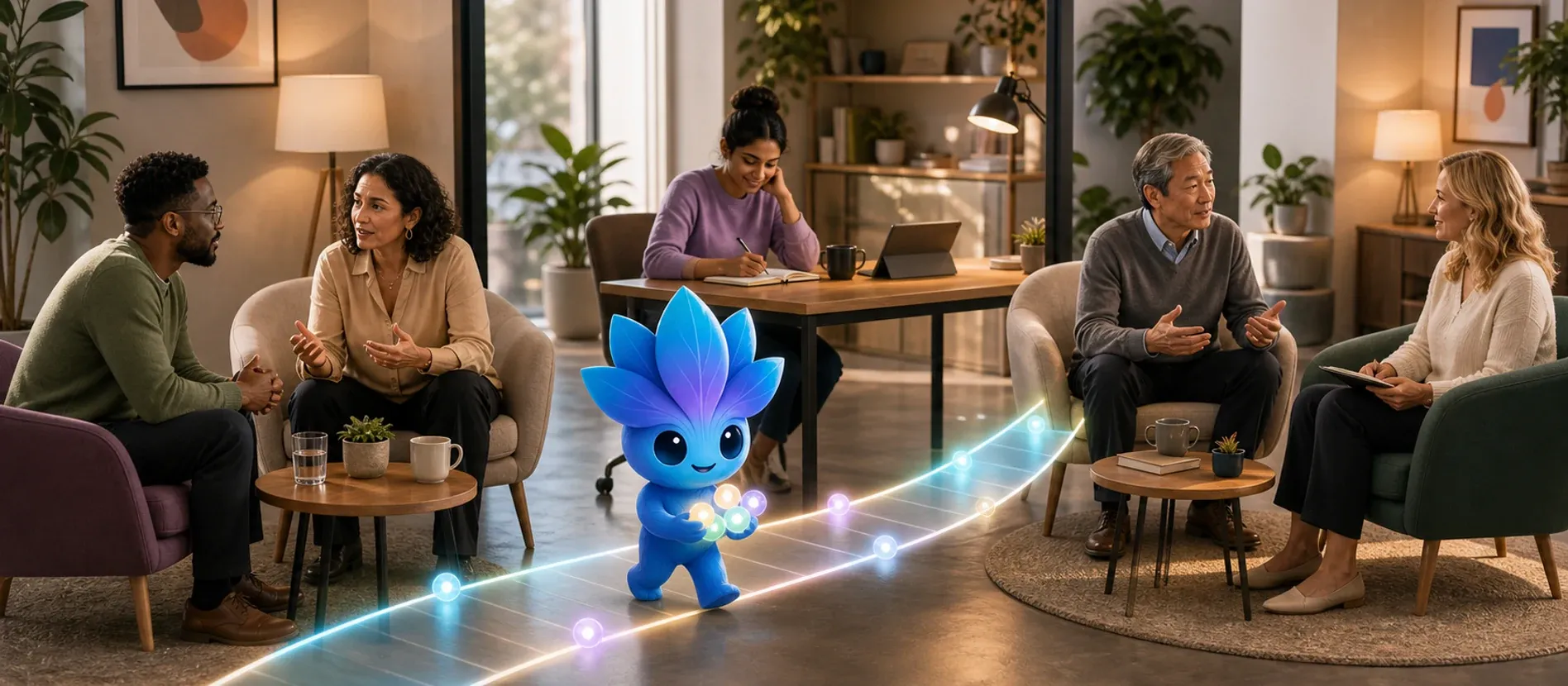
95% of coaching happens between sessions: how to support the inter-session
The real lever of change isn't the session, it's what your coachee lives between two. How to support the inter-session without adding to your workload or losing control.

Loïc Wan-Ajouhu
Co-Founder of Vikl, former CFO at VINCI Construction
In short. A coaching session lasts an hour or two. The rest, that is, 95% of your coachee's time, happens without you. That's where transformation holds or falls apart. The point isn't to coach more, but to help your coachee reach for the right reflex at the right moment, in the real situation. A companion tuned to your method can extend your frame between sessions, without ever replacing you and without touching confidentiality.
The session isn't the moment of transformation
We tend to think of coaching through the session. That makes sense: it's where everything visible happens. The realization, the click, the reframe that shifts the whole perspective. You know better than anyone, these are powerful moments.
But run the numbers. Two sessions a month, an hour each, is two hours out of a month that holds more than seven hundred. In other words, about 95% of your coachee's time unfolds between two sessions, in daily life, far from your eyes and your frame.
That's where transformation really plays out. The session triggers, the inter-session transforms, or doesn't. A coachee can walk out of a session bright and determined, then three days later get swept into a tense meeting where they do exactly what they had decided to stop doing. The work didn't fail. It simply dissolved into reality, for lack of a relay at the right moment.
This doesn't devalue the session, it shifts the question. Your value as a coach is the depth of the relationship, the quality of the questioning, the frame you set. The limit isn't in what you do: it's in the format. Sessions spaced apart cannot, on their own, cover the remaining 95%.
The first 48-hour window
What happens right after the session carries weight. An intention voiced in the heat of the moment stays vivid for a few hours, then it erodes. Attention fades, requests pile back up, and the brain, to save energy, returns to its automatisms.
Old reflexes, for their part, need no upkeep. They're hardwired. Under pressure, fatigue, or stress, it's always the shortest path that wins, the path of habit. The fine resolution made in session meets the first real situation and, often, bends.
Hence the importance of this first forty-eight-hour window. It's the moment when the intention is still available but already fragile. A coachee who reactivates their decision in that window, who confronts it with a concrete situation for the first time, anchors it far more solidly than one who waits for the next session to "take stock." Between the two, two weeks have passed, and with them a dozen missed chances to practice.
So the problem isn't your coachee's motivation. It's the delay. The need surfaces on a Tuesday at 6 p.m., the session is the following Thursday. Two weeks between the moment support would help and the moment it arrives.
Why classic homework isn't enough
To fill that gap, many coaches lean on relays between sessions. They're useful, but each has its limit.
The journal. Excellent for stepping back, provided it gets kept. In practice, it demands a discipline that a high-pressure routine quickly breaks. And it works after the fact, once the situation has passed, rarely in the moment when the reflex is at stake.
Micro-commitments. "This week, I'll observe my reactions in meetings." Great the day you decide it. Much hazier the following Thursday, when the commitment has dissolved into mental load. With no reminder or follow-up, the intention evaporates.
Reminders and notifications. They keep the topic present, but they don't support reflection. A "remember your goal" alert doesn't help someone who, right now, doesn't know how to phrase a course correction without putting their report on the defensive. The reminder points to the what, never the how.
What these tools have in common: they're static and out of sync. They don't adapt to the precise situation the coachee faces, and they don't arrive when the need is sharp. Yet that's exactly what would make the difference: contextual support, available when the situation shows up, not two weeks later.
The right reflex, at the right moment, in the real situation
Picture the same scene with a relay available on the spot. Your coachee has to announce an unpopular decision to their team in two hours. The session is in ten days. Instead of stewing alone or improvising on the fly, they take five minutes to lay out the situation, clarify their intention, anticipate the reactions and choose their opening sentence.
This isn't a coaching session. It's a targeted nudge, exactly when it counts, that helps your coachee mobilize what you worked on together rather than fall back into automatism. Transformation happens there, in the real situation, not in the debrief that comes later.
That's precisely the logic of a companion like Vikl: being available in the 95% where you can't be, to help your coachee apply your work in their daily life. On how human support and this kind of backup complement each other, see individual coaching and AI-augmented coaching, and for the concrete case of team tensions, a companion for difficult managerial situations.
Are you a coach? VIKL extends your support between sessions, in your method and with full respect for your coachees' confidentiality. Discover the coach offer.
Extending your frame, not diluting it
The legitimate fear, when we talk about a tool between sessions, is that it speaks in your place and blurs your frame. The aim is the opposite.
The companion speaks your language. You tune it to your method: vocabulary, tone, posture, your signature tools, whether that's DISC, NVC, Process Com, Gestalt or your own approach. Between sessions, your coachee doesn't run into a generic voice pulling them elsewhere, but the coherent extension of your work. The Vikl foundations, organizational psychology and mediation, stay in place beneath your customization. The detail of that setup is described in personalizing the AI agent to your coaching method.
You stay the architect. From your admin space, you push the individualized modules, exercises and questionnaires you judge useful for each coachee. You decide what gets worked on between sessions. The companion carries out your intention, it doesn't replace it.
You keep the relationship. The goal isn't for your coachee to need you less, but to arrive better prepared, having practiced, having tested. Your sessions move up a notch: less time spent re-framing, more time spent going deep. The inter-session feeds the session instead of competing with it.
Measuring engagement without reading conversations
One question remains for any serious coach: how do you know whether the inter-session is working, without betraying the coachee's trust?
The answer lies in a clean separation. You see engagement, never content. The companion surfaces usage signals: has your coachee interacted this week, have they progressed on the modules you pushed, at what pace. You walk into the session knowing where the dynamic stands, without having read a single line of their exchanges.
This confidentiality "by design" isn't a slogan. The content of the conversations stays the coachee's, full stop. That's what lets your coachee open up freely between sessions, and it's also what protects your professional ethics. The approach is compatible with the ICF, EMCC and SF Coach frameworks. The AI is hosted in France (Azure France Central), with encryption in transit and at rest, in compliance with GDPR and the AI Act. How to steer that dynamic is detailed in steering your coachees' engagement without reading their conversations.
This visibility changes your posture. You no longer wait for the session to discover a coachee has dropped off. You see it coming, you adjust, you follow up. You steer the journey over time, not just in one-hour bursts every two weeks.
In summary
The session triggers, the inter-session transforms. As long as the 95% of your coachee's time stays without a relay, part of your work dissolves into daily life and old reflexes. Equipping the inter-session with a companion tuned to your method means offering the right reflex at the right moment, while keeping the relationship, control of the journey and your coachees' confidentiality. You don't coach more. You coach further.
Related articles
Will AI replace coaches? What the profession risks (and doesn't)
Will AI replace coaches? The real answer: it shifts the value of the job toward what it can't do. Relationship, presence, meaning. What changes, and what doesn't.
Assigning personalized exercises and training to each coachee from your dashboard
How to push individualized modules, exercises and questionnaires to each coachee from your admin space, structure the journey between sessions and stay in control, without extra workload.
Scaling your coaching impact without diluting your practice: the augmented-coaching model
Augmented coaching: extend your reach to more coachees and more moments, without sacrificing quality or your singularity. The framework to break the billable-hours ceiling.